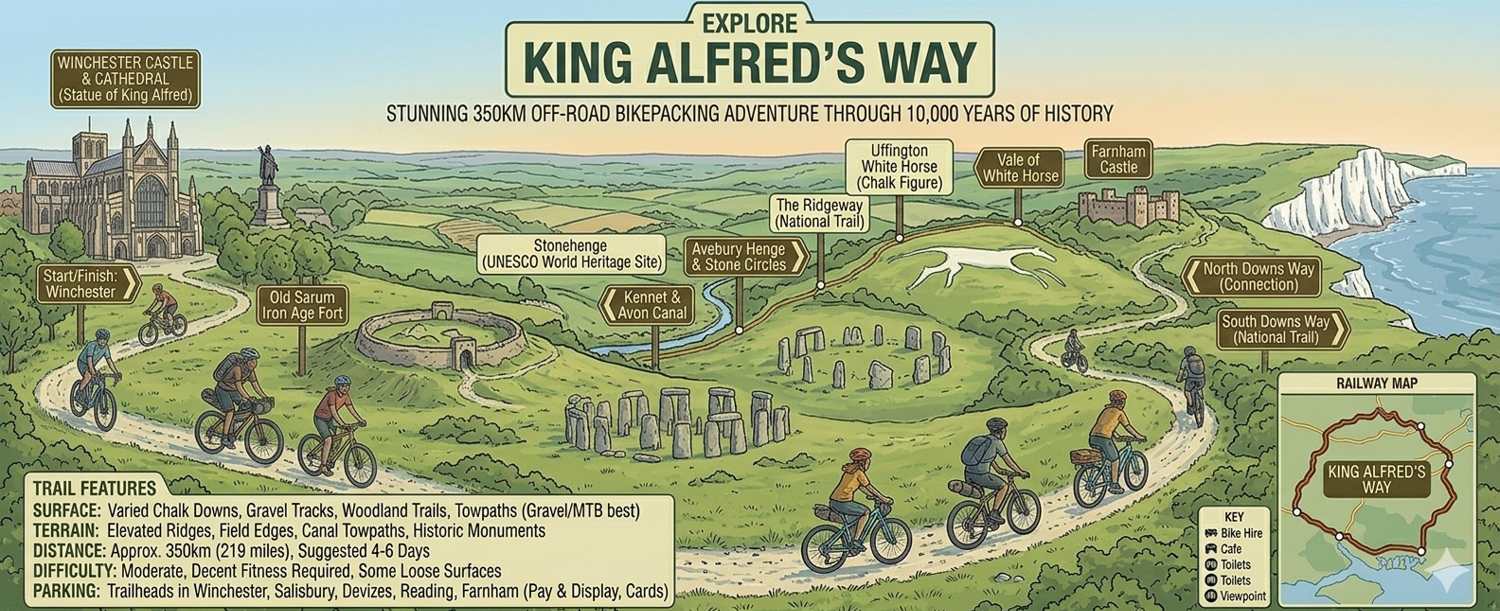
King Alfred’s Way Cycle Route
Start: Winchester
Distance: 218 miles
Terrain: Mainly off road traffic free byways and bridleways. Some quiet roads
Bike Types: Mountain bikes, Hybrid
Grading : Moderate
GPX: King Alfred’s Way GPX
King Alfred’s Way is one of England’s best long-distance off-road cycling routes, taking riders on a 219-mile (353km) circular journey through the historic landscapes of Wessex. Starting and finishing in Winchester, the route combines gravel tracks, bridleways, byways, quiet lanes and sections of established long-distance trails.
The route was created by Cycling UK and launched in 2020. It passes through Hampshire, Wiltshire, Berkshire and Surrey, linking spectacular countryside with some of southern England’s most important historic sites.
For cyclists looking for a challenging bikepacking route in the UK, King Alfred’s Way offers an excellent mixture of off-road riding, history, scenery and adventure.
King Alfred’s Way at a Glance
- Distance: approximately 219 miles (353km)
- Route type: Circular long-distance cycling route
- Start and finish: Winchester, Hampshire
- Terrain: Gravel tracks, bridleways, byways, trails and quiet roads
- Elevation gain: approximately 11,461ft (3,493m)
- Difficulty: Moderate to challenging
- Best bikes: Gravel bike or mountain bike
- Suitable for: Experienced cyclists and bikepackers
- Navigation: GPS/GPX navigation strongly recommended
What is King Alfred’s Way?
King Alfred’s Way is a circular cycling route around the heart of historic Wessex. The route is named after Alfred the Great, the Anglo-Saxon king who ruled Wessex and whose statue stands in Winchester at the start and finish of the route.
The route was designed as an off-road cycling adventure and incorporates sections of several established trails, including the Ridgeway, South Downs Way, North Downs Way and Thames Path.
Along the way cyclists encounter chalk downs, gravel tracks, woodland, heathland, quiet country lanes and open countryside, as well as historic monuments dating back thousands of years.
King Alfred’s Way Route Map and GPX
A GPS route file is highly recommended when riding King Alfred’s Way. Although sections of the route are easy to follow, there are areas where navigation can be more complicated.
Download the King Alfred’s Way GPX route and load it onto your Garmin, Wahoo or other GPS cycling computer before setting off. It is also sensible to carry a backup navigation option, particularly for a multi-day bikepacking trip.
Always check the latest route information before riding, as temporary diversions, path restrictions and local conditions can affect the route.
How Long is King Alfred’s Way?
The complete King Alfred’s Way route is approximately 219 miles (353km). The route also includes around 11,461 feet (3,493 metres) of climbing, making it a substantial challenge for most cyclists.
Most riders tackle the route over several days rather than attempting it in a single ride. Your ideal itinerary will depend on your fitness, bike, luggage, weather conditions and how much time you want to spend visiting the historic attractions along the route.
How Many Days Does King Alfred’s Way Take?
There is no single correct itinerary for King Alfred’s Way. Experienced bikepackers may complete the route in three or four days, while riders who prefer a more relaxed trip may take five or six days.
A 4–5 day itinerary provides a good balance between daily mileage and time to enjoy the scenery, villages and historic sites along the way.
Example 5-Day Itinerary
- Day 1: Winchester to the Salisbury/Stonehenge area
- Day 2: Stonehenge area through Wiltshire towards Avebury
- Day 3: Avebury and the Ridgeway towards the Thames Valley
- Day 4: Thames Valley through Berkshire and Surrey
- Day 5: Surrey and the South Downs back to Winchester
This is only an example. Accommodation availability and personal fitness are likely to determine the best way to divide the route.
What Bike is Best for King Alfred’s Way?
A gravel bike is an excellent choice for King Alfred’s Way, particularly in dry conditions. The route was designed with gravel riding in mind and includes a large amount of off-road riding.
A mountain bike can be a better option when conditions are wet or muddy, particularly if you prefer additional grip and comfort on rougher sections.
A hybrid bike with suitable tyres may also be capable of tackling sections of the route, but riders should consider the amount of rough and sometimes uneven terrain before choosing their bike.
Recommended Bike Setup
- Gravel or mountain bike
- Wide, puncture-resistant tyres
- Reliable mechanical or hydraulic disc brakes
- Low gearing for steep climbs
- Front and rear lights
- Spare inner tubes or tubeless repair equipment
- Mini pump or CO2 inflator
- Basic bike tools and spare chain links
King Alfred’s Way Terrain
Although King Alfred’s Way is not an extreme mountain-bike trail, riders should be prepared for a mixture of surfaces and conditions.
The route includes gravel tracks, chalk tracks, bridleways, byways, grassy tracks, woodland trails and quiet country roads. Some sections can become muddy, slippery or rutted after heavy rain.
The Ridgeway and South Downs sections can be particularly demanding in poor weather, while chalk surfaces can become slippery when wet.
Highlights Along King Alfred’s Way
One of the great attractions of King Alfred’s Way is the combination of cycling and history. The route passes through landscapes containing thousands of years of human history.
Winchester
Winchester is the traditional starting and finishing point for King Alfred’s Way. The city has strong connections with Alfred the Great and is an excellent place to begin or finish a cycling trip.
Stonehenge
The route passes close to Stonehenge, one of Britain’s most famous prehistoric monuments and a UNESCO World Heritage Site.
Avebury
Avebury is another major prehistoric attraction along the route. The enormous stone circle and surrounding landscape provide one of the most memorable stops on the journey.
Old Sarum
Near Salisbury, Old Sarum provides another opportunity to explore the area’s ancient and medieval history.
Barbury Castle
Barbury Castle is an Iron Age hill fort situated along the route and offers impressive views across the surrounding countryside.
The Ridgeway
King Alfred’s Way follows sections of the ancient Ridgeway, one of Britain’s most historic long-distance routes. The elevated chalk landscape provides some spectacular cycling.
South Downs
The southern section of the route connects with the South Downs Way before returning towards Winchester.
King Alfred’s Way Bikepacking
King Alfred’s Way is particularly well suited to bikepacking. The circular route allows cyclists to carry camping equipment or lightweight luggage and stay overnight at campsites, B&Bs, hotels and other accommodation along the way.
For a multi-day trip, keep luggage as light as possible. The combination of long distances, climbing and rough surfaces means that a heavy touring setup can make the route considerably harder.
Accommodation on King Alfred’s Way
There are accommodation options in towns and villages around the route, including campsites, B&Bs, hotels and self-catering accommodation.
Popular areas for an overnight stop include Winchester, Salisbury, Andover, Marlborough, Avebury, the Thames Valley, Reading and Farnham.
Wild camping should not be assumed to be permitted. If you intend to camp, use established campsites and check availability before starting your trip, particularly during weekends and the summer season.
The Chapel B&B Tadley. Double or single rooms available or the whole chapel.
Rowbury Farm Camping, Andover. First class loos and showers.
Porkers Cottage and Stables, Aldermaston, Studio rooms and shepherds hut.
The Chapel Bed & Breakfast, Tadley. Luxury detached self-contained annexe
Stowford Manor Farm, Trowbridge – Camping, swimming club, workshops.
The West Wing, Everleigh – Accommodation, self catering, breakfast. Near Stonehenge.
The Stones Hotel, Salisbury – Accommodation, restaurant, near to Stonehenge.
Totteridge Farm, Pewsey – camping, camping pods, caravans, motorhomes
The Kingsbury, Marlborough – We are a limited service B&B/hotel concept offering fabulous accommodation without the need for a reception or keys. We have a lockable garage for guests to be able to store their bikes.
The Five Bells Wickham – Accommodation, drinks, meals
Talmage House B&B, Malborough – Secure bike storage in garage, garden and summerhouse
Silbury House B&B, Avebury – Rooms and secure bike storage
Overtown Manor B&B, Swindon – Holiday Lets. Bed and breakfast, secure bike storage, near the Ridgeway.
Food and Water
Although the route passes through a number of towns and villages, there are also long stretches of open countryside where food and water are less readily available.
Plan your resupply points before setting off each day and carry sufficient water, food and emergency supplies for the more remote sections.
When is the Best Time to Ride King Alfred’s Way?
Late spring, summer and early autumn can provide good conditions for riding King Alfred’s Way, although the route can be ridden throughout the year by suitably equipped cyclists.
Dry weather makes the gravel and chalk tracks considerably easier. After prolonged rain, some off-road sections can become muddy and slippery, making a mountain bike and wider tyres a sensible choice.
Always check the weather forecast and local route conditions before setting off.
King Alfred’s Way Cycling Tips
- Download your GPX route before leaving home.
- Carry enough food and water for remote sections.
- Check the weather forecast before each day’s ride.
- Use wider tyres for additional comfort and grip.
- Carry tools and spares for common mechanical problems.
- Book accommodation in advance during busy periods.
- Allow extra time for muddy or difficult conditions.
- Take care on descents and loose chalk surfaces.
- Keep your phone and GPS device charged.
- Check for route updates and temporary diversions before setting off.
Is King Alfred’s Way Suitable for Beginners?
King Alfred’s Way is achievable for cyclists with reasonable fitness, but it should not be regarded as an easy beginner’s cycling route. The distance, climbing, off-road terrain and multi-day nature of the challenge require preparation.
If you are new to bikepacking, consider building up your experience with shorter overnight cycling trips before attempting the full 219-mile route.
King Alfred’s Way – Frequently Asked Questions
How far is King Alfred’s Way?
King Alfred’s Way is approximately 219 miles (353km) long.
Where does King Alfred’s Way start?
The route starts and finishes in Winchester, Hampshire, at the statue of King Alfred the Great.
Is King Alfred’s Way off road?
King Alfred’s Way is predominantly an off-road route using bridleways, byways, gravel tracks and other trails, with some sections on quiet roads.
What type of bike is best for King Alfred’s Way?
A gravel bike is particularly well suited to the route. A mountain bike can be preferable in wet or muddy conditions.
Can you camp on King Alfred’s Way?
Yes, there are campsites close to the route, making it suitable for bikepacking. Riders should use authorised campsites rather than assuming wild camping is permitted.
Is King Alfred’s Way suitable for bikepacking?
Yes. The 219-mile circular route is an excellent multi-day bikepacking adventure and can be completed over several days depending on fitness and experience.
Do I need a GPS for King Alfred’s Way?
A GPS cycling computer or navigation app is strongly recommended. Some sections are more straightforward to navigate than others, so downloading the GPX route before setting off is advisable.
Plan Your King Alfred’s Way Cycling Adventure
King Alfred’s Way combines some of the best ingredients of a British cycling adventure: challenging off-road riding, beautiful countryside, historic landmarks and the freedom to travel under your own power.
Whether you are planning a fast gravel-bike adventure or a relaxed multi-day bikepacking trip, the route offers an excellent way to explore the historic landscapes of southern England.
Planning a longer cycling adventure? Explore more UK cycling routes and long-distance bike trails on Savvy Cycling.
Related Cycling Routes
King Alfred’s Way Information
Cycle shops in Hampshire for repairs, servicing and spares.